
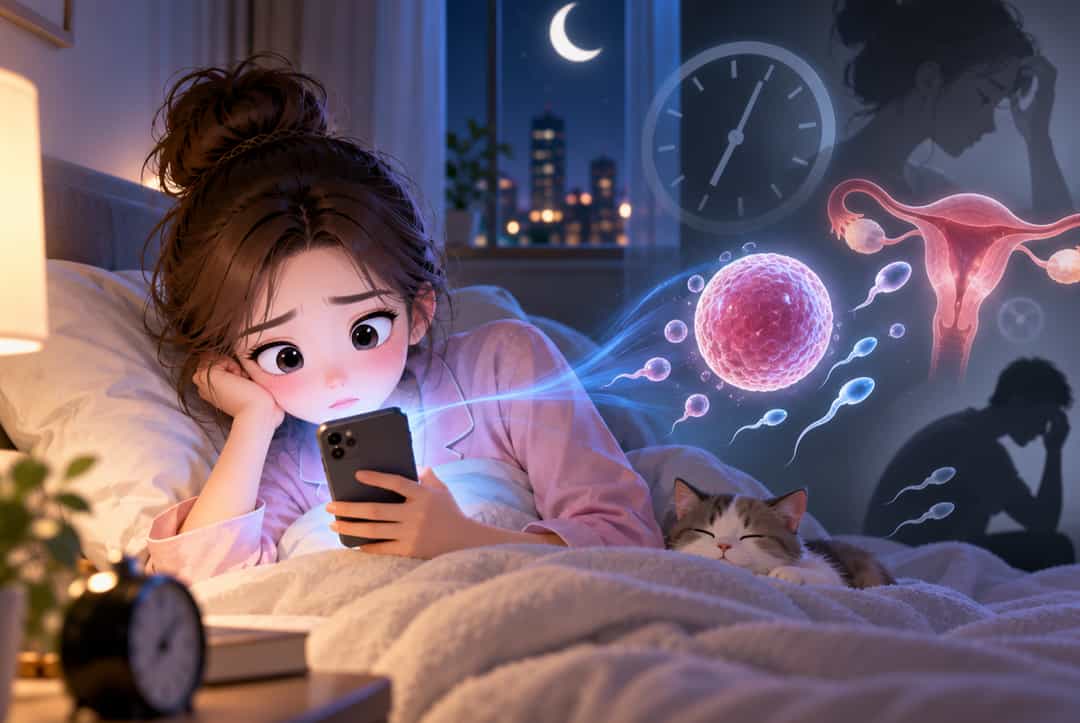
Still scrolling your phone before bed? If you’re trying to conceive or undergoing IVF, the light you really need to watch out for might be this one.
Many couples trying to conceive are willing to change their lifestyle for the sake of a healthy baby.
They start exercising regularly, adjusting their diets, supplementing folic acid, quitting smoking and alcohol, and tracking ovulation. Those preparing for IVF may even begin optimizing their physical condition several months in advance. For families planning to seek fertility treatment abroad, every step is carefully considered—from selecting a hospital and undergoing evaluations to developing a third-generation IVF plan in Thailand.
But one detail is easy to overlook: right before you go to sleep at night, are you still scrolling on your phone? After turning off the bedroom lights, you lie in bed watching short videos, replying to messages, or streaming a show. The phone gets put away, but the bedside nightlight stays on all night. The indicator lights on the TV, router, and chargers remain glowing. The real concern with these seemingly minor sources of light is not that "glancing at your phone will directly harm your eggs or sperm," but rather long-term nighttime light exposure and the circadian disruption that comes with it.
For couples who are trying to conceive naturally, undergoing assisted reproductive treatment, or planning IVF in Thailand, sleep and the light environment around you deserve just as much attention as any other part of your health routine.
1. Why does light at night have anything to do with fertility?
To understand this, it helps to start with a hormone most people are familiar with—melatonin. Many people first hear of melatonin because they have trouble falling asleep. In fact, melatonin is closely tied to the body's circadian rhythm. As night falls and the environment gradually darkens, melatonin secretion typically increases. When light enters the eyes, however, it signals to the brain that the environment is still "bright," which can interfere with normal nighttime physiological rhythms.
So what really matters is not "how dangerous the phone itself is," but rather: our bodies have entered nighttime mode, but the light signals reaching our brains say it is still daytime. Over time, sleep duration, sleep quality, circadian rhythm, and certain endocrine activities can all be affected.
2. Melatonin does more than "help you sleep"—it is also linked to reproductive health
In reproductive medicine research, one important reason melatonin draws attention is its antioxidant properties. The body produces free radicals during normal metabolism, and when oxidative stress levels become too high, a wide range of cells—including sperm and oocytes—can be affected.
For women, the journey of an oocyte from growth and maturation to completing meiosis is a highly complex process. For men, sperm production, maturation, motility, and DNA integrity can also be influenced by oxidative stress and other factors. From a reproductive health perspective, then, melatonin is not simply about making you drowsy—it also participates in regulating the body's circadian rhythm and antioxidant systems.
But one point must be emphasized: this does not mean that higher melatonin levels automatically mean better eggs or sperm, and it certainly cannot be simplified to "taking melatonin will improve IVF success rates." The normal circadian rhythm that comes from daily life is a completely different concept from self-administering melatonin supplements. In particular, anyone currently undergoing ovarian stimulation, egg retrieval, embryo transfer, or other reproductive treatment should not start any new medication or supplement on their own based on research they have read.
3. Men should not assume this topic only applies to women
A common misconception when preparing for pregnancy is that the woman needs to give up coffee, go to bed early, take folic acid, and track ovulation, while the man thinks "all I need to do is provide sperm." In reality, a man's lifestyle deserves just as much attention.
In one study involving 100 men, 50 men with idiopathic oligoasthenoteratozoospermia were compared with 50 men of normal fertility, with researchers analyzing serum and seminal plasma melatonin levels as well as nighttime light exposure. Serum melatonin levels were shown to be positively correlated with sperm motility.
Studies like this suggest that sleep, circadian rhythm, and nighttime light exposure may be associated with male reproductive health.
Furthermore, chronic late nights rarely occur in isolation. People who stay up late often also experience insufficient sleep, prolonged sitting, increased mental stress, irregular eating patterns, and higher rates of smoking and alcohol consumption.
So the real change needed is not simply "dimming your phone screen," but working toward a more stable and healthy daily rhythm. For men planning to conceive naturally or undergo IVF, sperm quality management should be part of the preconception plan.
4. For women, the bigger concern is long-term circadian disruption
The female reproductive system is regulated by a complex interplay of hormones. From follicle recruitment and growth to ovulation, corpus luteum formation, and the menstrual cycle itself, every stage involves intricate endocrine control.
One animal study found that under continuous nighttime light exposure, mice showed abnormalities in oocyte maturation, spindle assembly, and chromosome arrangement. It should be noted that animal studies cannot be directly equated with human clinical outcomes, but they do offer mechanistic clues for understanding the relationship between nighttime light exposure, circadian rhythm, and oocytes.
For women preparing for pregnancy—particularly those planning third-generation IVF in Thailand—rather than focusing all attention on "what to eat to nourish your eggs," it is equally worthwhile to prioritize sleep. An IVF cycle is itself a systematic process. Ovarian stimulation medications, ovarian response, follicle count, mature oocyte count, fertilization, embryo culture, and subsequent embryo screening—each step is influenced by different factors.
No single food, supplement, or lifestyle habit can determine the final outcome on its own. But improving sleep, reducing chronic late nights, and limiting unnecessary exposure to bright light at night are low-cost lifestyle adjustments that also benefit overall health.
5. Is it really fine as long as the main light is off while you scroll?
A common scenario: "I've already turned off the lights—I'm only scrolling for half an hour. Surely that's not a problem?" In reality, viewing a bright screen at close range in a dark room is exactly the kind of nighttime light exposure worth paying attention to. When the phone is held close to your eyes, the light from the screen enters directly and can affect the brain's ability to judge whether it is currently day or night. That said, there is no need to develop "light anxiety" over this. An occasional late-night reply or turning on a light before bed will not directly cause infertility, and one late night will not suddenly "ruin" this month's eggs or sperm.
What truly deserves caution is long-term, persistent, repeated late nights and nighttime light exposure. When preparing for pregnancy, the real concern is not the occasional irregular day—it is letting irregularity become a daily lifestyle.
6. Preparing for IVF? Four small habits to practice before bed
1. Set a "stop time" for your phone before bed
Try to reduce continuous use of electronic devices such as phones, tablets, and computers before sleep. You don't need to obsess over exactly "how many minutes before bed" is effective—the key is giving your body a steady pre-sleep transition. A warm shower, gentle stretching, reading a physical book, or listening to calming music are all better pre-sleep habits than lying in a dark room staring at a bright screen.
2. Keep your bedroom as dark as possible
If streetlights, signage, or hallway lights shine into your room, consider blackout curtains. If indicator lights from routers, chargers, or televisions face the bed, cover them as needed. The goal is not a bedroom that is "absolutely pitch black," but rather minimizing unnecessary and continuous nighttime light.
3. If you must turn on a light at night, choose soft, dim lighting
If you need to get up in the middle of the night to use the bathroom, drink water, or tend to a child, choose low-brightness, softer lighting. Avoid suddenly switching on a very bright overhead light, and resist the habit of picking up your phone after getting out of bed and scrolling for another half hour.
4. Don't stay in a dim room all day
Many people know to keep things dark at night, but forget that the body also needs normal exposure to natural light during the day. The circadian rhythm depends on a clear "day–night" contrast in the environment. Getting natural light and regular activity during the day, while reducing bright light and screen stimulation at night, supports a more stable sleep–wake rhythm.
7. Preparing for IVF in Thailand takes more than a flight ticket and a passport
For families planning fertility treatment abroad or cross-border conception, a great deal of time often goes into researching hospitals, doctors, stimulation protocols, accommodation, and flights before traveling to Thailand. These things matter, of course. But preparing your body should begin just as early. Families planning third-generation IVF in Thailand can, before formally starting their cycle, gradually build a regular routine, reduce chronic late nights, and complete the necessary evaluations—such as AMH, reproductive hormones, ultrasound, and semen analysis—as advised by their physician. Once in Thailand, the process continues with hospital appointments, doctor consultations, examinations, stimulation monitoring, egg retrieval, embryo culture, and follow-up procedures.
For first-time families traveling to Thailand, an unfamiliar healthcare system, language barriers, and logistical coordination can sometimes feel more stressful than the treatment itself.
HuanQiu XinSheng provides full-cycle third-generation IVF services in Thailand—from organizing preliminary test results and discussing treatment plans, to booking hospitals and doctors, and then providing airport transfers, interpretation, overseas medical accompaniment, and care coordination after arrival. The goal is to help families focus their energy on treatment and their own health, rather than getting caught up in the many logistical details of an unfamiliar environment.
A final thought: what truly deserves to change isn't only the phone by your bed
Fertility is never determined by any single factor. Age, ovarian reserve, sperm quality, underlying medical conditions, genetic factors, lifestyle, and the specific assisted reproduction plan can all influence the final outcome. We should not exaggerate "nighttime light exposure" into the sole cause of infertility or IVF failure.
But it does remind us of something important: many health-related habits do not cause problems suddenly—they accumulate quietly through the rhythm of daily life.
If you have decided to start trying to conceive, or you are preparing for IVF, third-generation IVF in Thailand, or fertility treatment abroad, then beyond thinking about what to eat, what to supplement, and which hospital to choose, you can also start tonight: put the phone down a little earlier, dim the lights, and let your body find its natural nighttime rhythm again.
For families experiencing cross-border conception and overseas assisted reproduction, truly good preparation is never just about the journey itself—it is the thoughtful coordination of lifestyle, physical health, and medical planning.
HuanQiu XinSheng | Full-Cycle Fertility Management
May every careful preparation bring you one step closer to the new life you are waiting for.

- Previous
- Next