
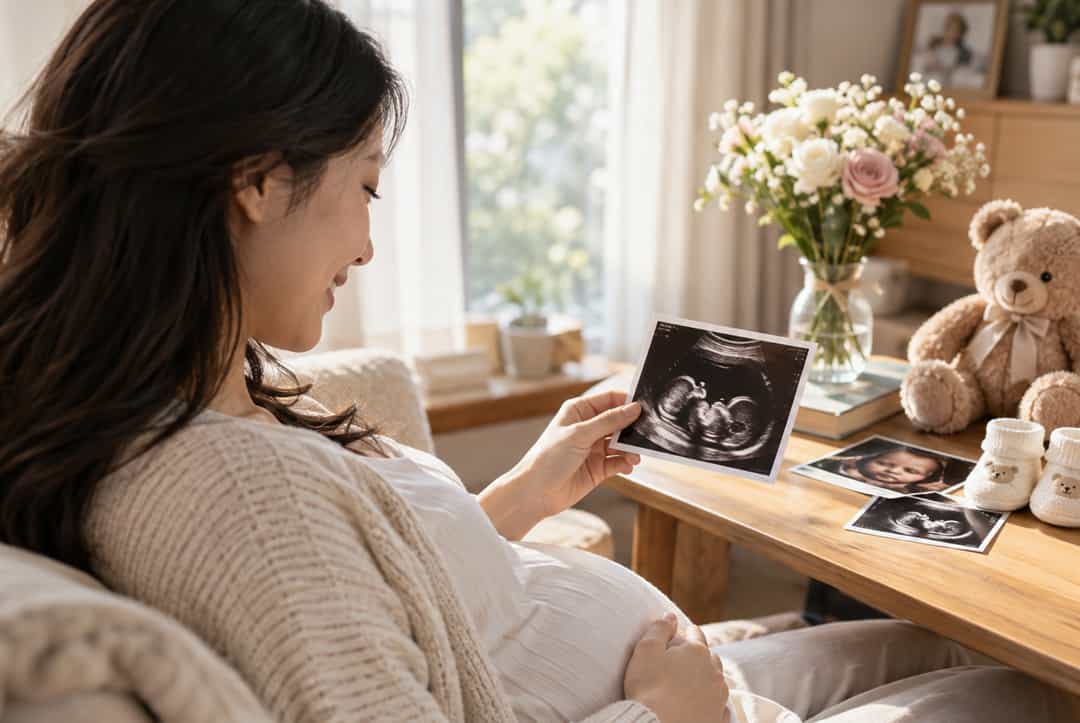
Who determines a baby’s facial appearance—is it truly decided by genetics alone? Research suggests that nutrition during the embryonic period may also play a role in “shaping” facial features.
I. A baby’s face begins an intricate “construction project” during the embryonic stage
Many expectant parents have discussed an interesting question: After birth, will the baby’s eyes look like mom’s, the nose like dad’s, or perhaps inherit the best features of both?
From a genetics perspective, a child’s facial features are of course influenced first by parental genes. But in reality, there is also an intriguing phenomenon: even with highly similar genetic backgrounds, the final facial form is not necessarily identical. Identical twins share almost identical genetic information, yet subtle facial differences can still exist; siblings in the same family also often have their own distinct facial characteristics.
This means the face we ultimately see is not a simple copy-and-paste of parents’ appearance. Genetic information provides the basic blueprint, while during embryonic development, cell growth, migration, differentiation, and the surrounding environment may all participate in shaping the final facial structure.
In recent years, a study focused on maternal protein intake, the mTORC1 signaling pathway, and offspring craniofacial development has offered an interesting perspective: the nutritional environment during the embryonic period may, through intracellular signaling systems, exert some influence on craniofacial development. The study’s focus was precisely to explore the cellular and molecular mechanisms by which maternal protein intake may affect offspring craniofacial bone development.
For families who are trying to conceive naturally, are already in IVF or Thailand third-generation IVF cycles, or are planning parenthood through overseas fertility treatment or cross-border childbirth, what truly deserves attention in this research is not “what to eat to make a baby more beautiful,” but a more important question: How exactly does the nutritional environment in the earliest stages of life participate in embryonic development?
To understand why nutrition may be linked to facial development, we first need to know how our face is actually formed.
In early embryos, there is a very important group of cells called neural crest cells. These cells migrate from near the neural tube to the future facial region, then gradually aggregate, proliferate, and differentiate, participating in the formation of cartilage, bone, and other craniofacial tissues. The formation of structures such as the nasal bridge, chin, and jawbones all depends on this highly precise developmental process.
If we compare the whole process to building a house, genetic information is like a set of “architectural blueprints,” while neural crest cells and the cartilage progenitor cells they later form are like the construction workers actually carrying out the work. Genes determine the overall direction, but whether these cells can proliferate normally, when they migrate, how they arrange themselves, and how large a tissue structure they ultimately form still require regulation by numerous cellular signals.
At this point, a very important cellular signaling system comes into play—mTORC1 (mechanistic target of rapamycin complex 1).
Simply put, mTORC1 is much like a “nutrient and energy sensing system” inside cells. When cells detect sufficient amino acids, glucose, and energy supply, this pathway helps regulate protein synthesis, cell growth, and proliferation; when nutrients and energy are insufficient, the corresponding growth activities are adjusted. More intriguingly, mTORC1 is not unique to humans; it is highly conserved across species such as yeast, zebrafish, mice, and humans, and is closely linked to important signaling pathways involved in craniofacial development, including Hedgehog, Wnt, and BMP.
This led scientists to a key question: Could maternal nutrient intake alter the nutrient signals received by embryonic cells and, through the “molecular bridge” of mTORC1, influence craniofacial tissue development?
II. With different maternal protein levels, measurable changes in facial development did appear in experimental animals
To find answers, researchers first conducted a series of experiments in mice and zebrafish.
In the mouse experiments, pregnant mice were fed diets with different protein ratios but controlled total calories, including low-, normal-, and high-protein groups. The results showed that under different nutritional conditions, some craniofacial structures of the embryos showed measurable differences: In the low-protein group, some nasal and mandibular cartilage structures of the embryos were relatively smaller and thinner; in the high-protein group, increased nasal cartilage thickness was observed, and some facial length and width parameters also showed subtle changes with protein levels.
What further led researchers to focus on mTORC1 was subsequent genetic intervention experiments. When scientists genetically caused the mTORC1 pathway in experimental mice to remain at a higher activity level, some of the facial differences originally produced by different dietary conditions disappeared. This suggests that mTORC1 may play a very key role—it “translates” external nutritional information into growth signals that cells can recognize, thereby participating in the development of craniofacial tissues.
Zebrafish experiments provided evidence from another direction. After researchers briefly inhibited mTORC1 activity during a specific developmental period, they observed narrowing of facial cartilage, curvature of some structures, and changes in overall craniofacial morphology. Notably, even if the intervention was not long, as long as it occurred during certain critical developmental windows, it could still affect subsequent structure formation. This suggests that there may be developmental stages in early embryos that are particularly sensitive to nutrition and cellular signals.
Looking further at the cellular level makes the answer even clearer. Researchers found that when mTORC1 activity changed, the number, proliferation status, and arrangement of cartilage-forming progenitor cells also changed. When mTORC1 activity was higher, some cartilage progenitor cells might form larger clonal clusters; when activity was lower, cell proliferation decreased, and the resulting structures might correspondingly become smaller, thinner, or shorter. In other words, nutrition does not directly determine whether a baby’s “nose is high or chin is pointed”; rather, it may subtly regulate craniofacial development by influencing cell growth and tissue organization.
So, continuing the “house-building” analogy makes it easy to understand: genes provide the design blueprint, cells carry out construction, and mTORC1 is more like a scheduling system that adjusts the pace of construction according to nutrient and energy supply.
III. Do phenomena found in animal experiments also exist in humans?
This is also the part of the entire study that requires the most cautious understanding.
Mouse and zebrafish experiments can help scientists study biological mechanisms, but results from animal experiments cannot be directly equated with human pregnancy outcomes. That is, we cannot infer from craniofacial structural changes in experimental animals under different protein diets that “if pregnant women eat more protein, their babies will be more beautiful.”
However, human genetic studies have indeed provided some clues worth further exploration. Related genome-wide association studies have found that multiple genetic variants in the PI3K/AKT/mTORC1 pathway are associated with some facial morphological differences in the general population; in addition, some genetic diseases involving abnormal mTORC1 activation may also be accompanied by abnormalities in craniofacial bone structure.
These studies give us a more complete understanding of “who determines appearance”: Human facial morphology itself is a very complex polygenic trait. Genetics determines important basic frameworks, but during the long and intricate process of embryonic development, nutrition, metabolism, and other environmental factors may also participate.
Therefore, children born to the same parents will not have exactly the same face, and even identical twins may gradually show subtle differences as they grow and develop.
But a boundary must be clearly drawn here: “nutrition may participate in facial development” and “designing a baby’s appearance through diet” are completely different things.
The key dietary experiments in the original study mainly came from animal models, and the experimental conditions were strictly controlled. The research revealed a potential basic biological mechanism, not a “beauty diet” that can be directly applied to pregnant women. The original article also clearly reminds readers that human facial development is extremely complex and influenced by multiple genes and the environment, and there is no situation in which eating a certain food can achieve a so-called “cosmetic surgery” effect.
IV. If you are trying to conceive or undergoing IVF, what truly matters is “nutritional balance”
For families trying to conceive or receiving IVF or Thailand third-generation IVF treatment, it is easy to have a new question after reading this: Since protein is related to embryonic development, is it better to supplement more protein starting before transfer?
This should not be understood that way either.
Protein is indeed an important nutrient for the human body and an indispensable basic material for tissue growth and repair. A rapidly developing fetus during pregnancy naturally also needs sufficient protein supply. But there is a very clear difference between “needing enough” and “the more, the better.”
In daily diet, fish, poultry, eggs, lean meat, dairy, beans, and soy products can all provide protein from different sources, while also bringing in fatty acids, calcium, iron, and various vitamins and minerals. Therefore, rather than simply pursuing “high protein,” a more scientific direction is still a diverse diet, balanced nutrition, and moderate intake. One should not rely on a single protein source. Every pregnant woman’s physical condition and fetal development are different, and specific nutritional plans should be based on prenatal checkups and professional guidance, rather than self-prescribing large amounts of high-protein supplements.
This is especially worth noting for families entering assisted reproductive cycles through overseas fertility treatment or cross-border childbirth. From ovarian stimulation, egg retrieval, blastocyst culture, embryo testing, to embryo transfer and pregnancy confirmation, the body’s condition is not exactly the same at different stages, and diet and nutrition management cannot simply follow one fixed template.
During overseas medical accompaniment, Global New Life also recommends putting the individualized advice of reproductive and prenatal doctors first, rather than self-prescribing large amounts of protein powder or other nutritional preparations after seeing a certain animal study. The real inspiration from scientific research is not to look for a “miracle food,” but to pay more attention to an overall, stable, and appropriate bodily environment during embryonic development.
In closing: A baby’s face is a “work” completed jointly by genes and life development
We often say the baby’s eyes look like mom’s, nose like dad’s, and mouth like grandpa’s. But from the perspective of modern developmental biology, the formation of a face is far more complex than a simple “genetic puzzle.”
Genes provide the most important blueprint, cells complete the construction step by step, and the nutritional and metabolic environment in which the embryo develops may participate in regulating this precise project.
The real value of mTORC1-related research is not to tell expectant mothers “how to eat to make the baby more beautiful,” but to help us see that in the earliest stages of a new life, nutrition, metabolism, cellular signaling, and genetic programs may already have begun an extremely complex conversation.
For families undergoing IVF, Thailand third-generation IVF, overseas fertility treatment, or cross-border childbirth, rather than chasing a so-called “baby beauty diet,” it is better to return attention to what truly matters: a reasonable diet, a regular lifestyle, standardized examinations, and professional medical advice based on one’s own situation.
Science cannot design a baby’s future face in advance, but it is gradually telling us: from a tiny embryo to a complete new life, every step is more intricate than we imagine.
Global New Life | Full-Cycle Fertility and Pregnancy Management
Focusing on IVF, Thailand third-generation IVF, overseas fertility treatment, cross-border childbirth, and overseas medical accompaniment services, we provide appointment coordination, translation accompaniment, travel transfers, and assistance with medical visit processes for families with cross-border fertility needs.

- Previous
- Next