
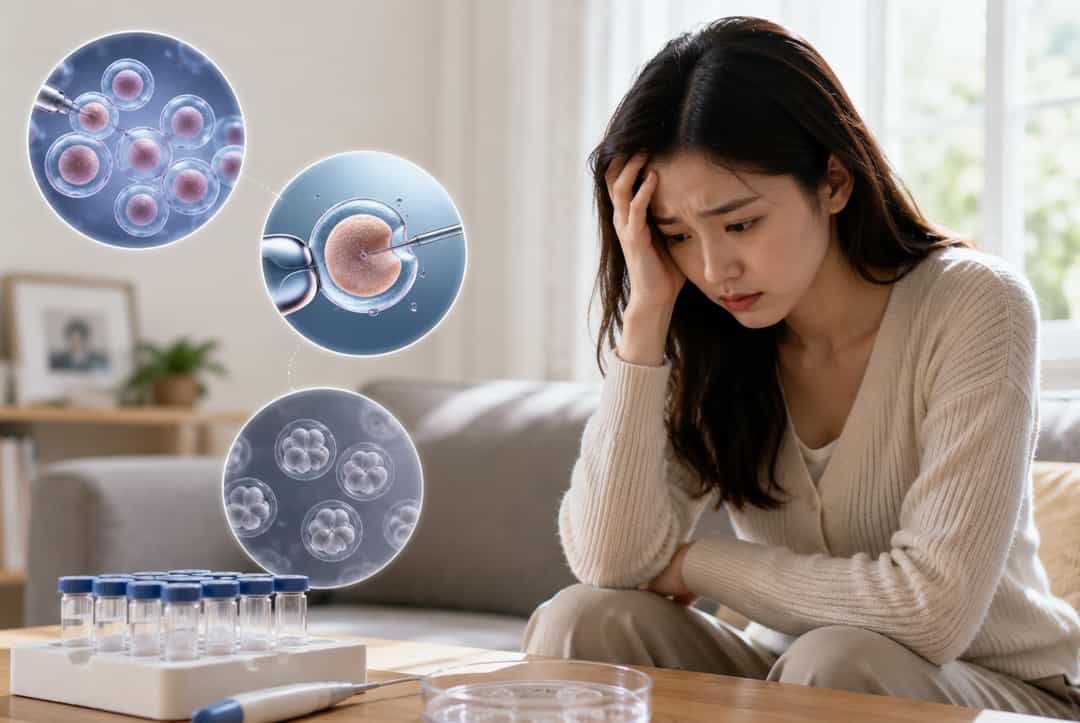
Many eggs were retrieved and fertilization was normal, so why was there not a single blastocyst in the end? The problem may not be just the stimulation protocol.
"I retrieved eggs, fertilization looked fine—so why did we end up with no blastocysts at all?" For anyone going through an IVF cycle, this can be one of the hardest outcomes to accept.
The earlier steps may all seem to go smoothly: ovarian stimulation, egg retrieval, fertilization. Step by step, you feel closer to having a transferable embryo—only to have everything come to a sudden halt at the embryo culture stage.
When this happens, many people's first instinct is: Was my stimulation protocol wrong? Were the medications incorrect? Would switching to a different stimulation approach next time solve the problem? But it may not be that simple. The risk of experiencing complete embryo arrest again is approximately 1.82 times higher than for other patients.
Research also suggests that simply changing the stimulation protocol or the trigger method has not been shown to significantly improve blastocyst formation rates. This is an important reminder for families pursuing third-generation IVF in Thailand or preparing to start another cycle: if the problem lies in the embryo development stage, focusing only on "which medication or protocol to switch to next time" may not be enough.
1. If fertilization succeeded, why can embryos still stop developing?
Many people tend to equate "successful fertilization" with "good embryo quality," but the two are not the same thing.
Sperm fertilizing the egg only means that the first step of embryo development has been completed. After that, the fertilized egg must undergo continuous cell division and gradually progress through the morula and blastocyst stages. During early embryo development, the material foundation and intracellular environment provided by the oocyte itself are critically important. One key term deserves special attention: mitochondria.
Mitochondria can be understood simply as the "energy factory" within cells. Oocytes contain a large number of mitochondria, and egg maturation, fertilization, and the continuous cell division of early embryos all require a steady energy supply.
Therefore, when there are problems with the oocyte's mitochondrial function, cytoplasmic maturity, or other intrinsic factors, subsequent developmental capacity may be affected even after successful fertilization. This is why some people may experience: adequate number of eggs retrieved → reasonable fertilization rate → but a noticeably lower proportion of embryos progressing further.
So, after embryo arrest occurs, the focus of the next cycle should not simply be "should I change my stimulation protocol?" Instead, a reproductive specialist should conduct a comprehensive assessment that takes into account age, ovarian reserve, previous stimulation response, mature oocyte ratio, fertilization results, embryo development milestones, semen parameters, and laboratory culture records.
2. If the first cycle ended with no blastocysts, is the next attempt likely to fail too?
This is the biggest worry for many families. The answer is not as pessimistic as one might think. Among people who have experienced complete embryo arrest, 66.4% of patients still successfully obtained blastocysts in their second cycle. Even more notably, once a blastocyst is successfully formed in a subsequent cycle, the study referenced above found no statistically significant difference in the rate of chromosomally normal embryos or the live birth rate after transfer, compared with people who obtained blastocysts in their first cycle. In other words: failing to produce a blastocyst once does not mean it will never happen, nor does it mean the IVF journey is over.
What truly matters is treating the first cycle as a highly valuable "clinical feedback" opportunity. For example, the doctor can further analyze: What was the proportion of mature oocytes among the eggs retrieved? At which step did fertilization occur? On which day did the embryos mainly arrest? Did high fragmentation or abnormal division rates occur repeatedly? Do male factors need further evaluation? How high is the age-related risk of chromosomal abnormalities?
For families planning to seek fertility treatment abroad or have a child overseas, or preparing to travel to Thailand for their next cycle, this information is even more important than simply "starting over at a different hospital."
3. Why does the preparation period between two stimulation cycles deserve attention?
Eggs do not suddenly begin developing on the first day of stimulation. A follicle needs to go through a longer physiological process to gradually grow from an early stage to final maturity. The referenced article describes this process as approximately 90–120 days, which makes the months leading up to the next cycle a preparation phase worth taking seriously. During this time, what is genuinely worthwhile is not frantically buying so-called "egg-boosting" products, but first identifying the specific factors that may be affecting reproductive status.
Age, ovarian reserve, sleep, weight, nutritional intake, smoking and alcohol use, metabolic status, and underlying medical conditions may all be part of the doctor's comprehensive evaluation. The key is not "the more supplements, the better," but whether they are necessary and suitable for your individual situation.
4. Can Coenzyme Q10, melatonin, and L-carnitine really "boost egg quality"?
Many people preparing for IVF probably have a long list of supplements saved on their phones. Coenzyme Q10, vitamin D, folic acid, DHEA, melatonin, L-carnitine... The more you read, the easier it is to get the illusion that as long as you take all the supplements, your egg quality will definitely improve. That is not how it works. Nutritional supplements are not a case of "the more, the better," nor can they be treated as a "standard answer" to embryo arrest. Supplements should be chosen based on your specific metabolic, inflammatory, and hormonal profile—not simply piled up. At the same time, lifestyle is an important part of overall metabolic health and mitochondrial status. Especially for those already in an IVF cycle, whether to take a particular supplement, the dosage, and how long to take it should be decided with your doctor's guidance and tailored to your own circumstances, rather than copied from someone else's "egg-boosting checklist."
5. More fundamental than "taking supplements obsessively" is lifestyle
Many people diligently research all kinds of nutritional products for the next egg retrieval while overlooking the most ordinary things: sleep, exercise, diet, and stress management. These may seem to have no "technical sophistication," but they are the essential foundation for maintaining normal metabolism and physical health. Supplements are "addition"; lifestyle is "multiplication."
If you stay up late every day, sit for prolonged periods, and have an unbalanced diet, pinning all your hopes on a few bottles of supplements is not an ideal preconception strategy. Processes such as mitophagy and mitochondrial biogenesis are closely related to the body's own metabolic state, and sleep, exercise, dietary patterns, and stress management all influence the overall metabolic environment. So, between two cycles, rather than chasing a so-called "universal egg-boosting protocol," it makes more sense to get the fundamental aspects you can control in order first.
6. After embryo arrest, what should the next cycle actually focus on?
If the first cycle did not produce a blastocyst, it is not advisable to simply chalk it up to "the hospital is no good," "the medication was wrong," or "bad luck." A more productive approach is to compile the complete data from the first cycle. The stimulation protocol, medication dosages, follicle development, number of eggs retrieved, number of mature oocytes, fertilization method, number of normally fertilized eggs, daily embryo development records, blastocyst culture results, and the male partner's semen parameters—all of these can serve as important evidence for developing the next strategy.
If you are planning third-generation IVF in Thailand, you can also discuss with your doctor whether there are medical indications for PGT-related testing, as well as arrangements for subsequent embryo culture, genetic testing, and transfer. PGT is not a method to improve egg quality, nor can it solve all problems of embryos failing to develop. Its primary role is to perform genetic testing on embryos that have already formed and reached testing criteria, when clinically indicated. This distinction is important to understand.
7. For cross-border IVF, don't just focus on "success rates"
For families preparing to travel to Thailand for IVF, the real issue to solve is often not just which hospital to choose.
How should previous cycle records be organized? Which examination reports should you bring? How can you accurately communicate the information about your first embryo arrest to a Thai doctor? Do you need additional tests? How do different doctors' recommendations for the next cycle differ? Once the cycle begins, how do follow-up visits, tests, translation, and travel logistics fit together? These details can directly affect the entire overseas medical experience.
Global New Life (Huanqiu Xinsheng) frequently encounters families who come to Thailand for re-evaluation after a previous failed cycle in our long-term overseas medical accompaniment services. For these clients, what we prioritize is not simply "starting over," but helping to organize previous cycle records as thoroughly as possible, connecting with Thai reproductive specialists, facilitating consultation communication, and coordinating the logistical flow during your stay in Thailand—so that the doctor can see a more complete picture of your previous cycle history.
For families seeking fertility treatment abroad or planning cross-border conception, one of the key values of professional overseas medical accompaniment is reducing information gaps and making every consultation and exchange clearer and smoother.
A final note: one cycle without blastocysts does not mean the next has no hope
Going through "eggs retrieved, successful fertilization, but ultimately no blastocysts" is genuinely disheartening. But don't be quick to blame a single medication, and don't sentence your next attempt to failure based on one outcome.
Among people who have experienced complete embryo arrest, more than two-thirds still went on to obtain blastocysts in their second cycle.
What is truly worth doing next is carefully reviewing the previous cycle, identifying possible contributing factors, and then working with your doctor to decide what to adjust and what to keep for the next cycle.
IVF is never simply a matter of "switching medications and trying again." Especially for families preparing to pursue third-generation IVF in Thailand, making good use of your previous cycle data and identifying the problem more clearly is often far more meaningful than blindly changing protocols.
Global New Life | Full-Cycle Conception Management
From organizing preliminary records and coordinating with hospitals and doctors, to overseas medical accompaniment and process coordination in Thailand, we support every family on their cross-border journey to parenthood—helping make complex matters clear, one step at a time.
Health Information Disclaimer: This article is intended for educational sharing on assisted reproductive health and does not serve as a basis for individualized diagnosis or medication decisions. Embryo developmental arrest may involve multiple factors, including oocyte, sperm, chromosomal, laboratory culture, and other influences. The specific causes and next steps should be determined by reproductive medicine professionals based on a complete review of your cycle records.

- Previous
- Next