
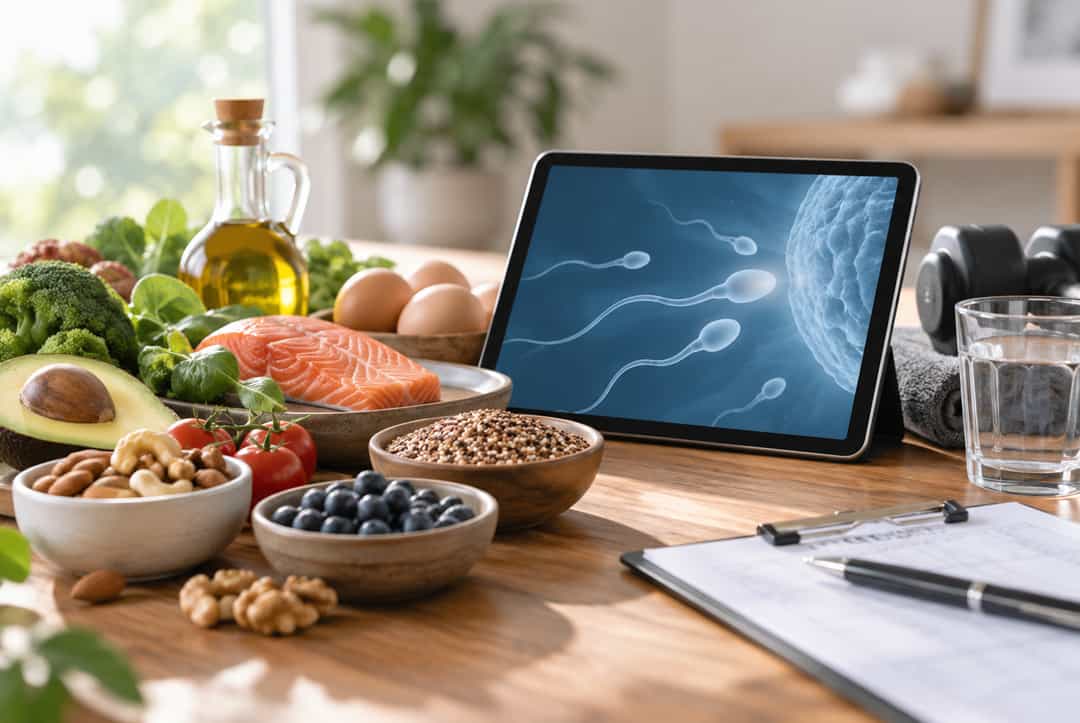
How Might a Husband’s Diet Affect Sperm and Embryo Quality? What Chinese Men’s Preconception Data Tells Us
When it comes to preparing for pregnancy, many families still react first with “the woman needs to get her body in good shape.” AMH testing, ovulation monitoring, ultrasound, folic acid supplementation, adjusting daily routines, weight control... every step seems to revolve around the woman. By contrast, the man’s role is often simplified to: abstain for a few days beforehand and go to the hospital to provide a semen sample.
But once you truly enter the field of reproductive medicine, you realize it is far from that simple.
Whether a couple is trying to conceive naturally or preparing for IVF or Thailand third-generation IVF, forming an embryo requires the joint participation of the egg and the sperm. Egg quality is certainly important, but sperm concentration, motility, morphology, and DNA integrity may also affect fertilization and subsequent embryo development. Therefore, for families pursuing fertility treatment overseas, cross-border childbirth, or already receiving overseas medical accompaniment and assisted reproductive treatment, the man’s preconception preparation is not simply a matter of “quit smoking and drinking.” It should be part of the overall fertility management process.
More importantly, a growing body of research is focusing on something we do every day but easily overlook—eating.
A Study Finds: What Men Eat May Be Associated with the Likelihood of Conception
This article cites a study published in Human Reproduction in 2023. The study followed 697 couples trying to conceive for 12 menstrual cycles, aiming to understand whether there is an association between men’s dietary patterns and the probability of conception.
The study found that higher total fat intake in men was associated with a higher probability of conception, with the highest intake group being approximately 1.43 times that of the lowest intake group. However, this result absolutely should not be simplistically interpreted as “eating more oil makes it easier to get pregnant.” The study used energy substitution analysis, and what truly warrants attention is the replacement relationship between nutrient sources: when total energy remains largely unchanged, replacing some refined carbohydrates with fat may be associated with better conception outcomes; however, when specific fat types such as Omega-3, Omega-6, and monounsaturated fats were analyzed, no clear independent associations were observed.
In other words, preconception preparation does not mean the man should suddenly start eating “rich, heavy meals.” What really needs adjustment is the overall dietary pattern. Instead of relying long term on sugary drinks, refined rice and flour products, and high-sugar snacks, it is better to shift part of the diet toward nuts, fish, whole grains, and other foods that better fit a healthy eating pattern.
This is also why, before IVF, the man’s preparation should not begin only a few days before semen collection. Semen quality reflects lifestyle, metabolic status, and the body’s internal environment over a period of time.
Data from Chinese Men Offer a Clearer Picture: Smoking, Alcohol, Diet, and Sleep All Deserve Attention
For Chinese families, a local study may be more informative.
A study published in Reproductive Health in 2023 included 466 men from the preconception counseling clinic of Guangzhou Women and Children’s Medical Center. Using semen testing combined with diet and lifestyle questionnaires, it analyzed the relationship between men’s daily habits and semen parameters.
The data showed that smoking was associated with poorer sperm progressive motility; alcohol consumption was associated with decreased progressive motility and total motility. At the same time, regular dairy intake was associated with higher sperm concentration and improved sperm motility, egg consumption was associated with semen volume, whole grain intake was associated with higher sperm concentration, and sufficient sleep was also associated with better sperm progressive motility. The study also observed an association between storing oil or seasonings in plastic bottles and lower sperm concentration.
Here, one scientific concept deserves special emphasis: “A statistical association” does not prove that a particular food can directly improve sperm quality. Diet, BMI, exercise, sleep, smoking, alcohol consumption, underlying diseases, and other factors are often intertwined, so seeing that “eating eggs” or “drinking milk” is associated with a certain semen parameter should not be interpreted as a treatment method.
What is truly meaningful is seeing a common direction in these data: male preconception preparation is not about relying on a single “supplement,” but about paying attention to the entire lifestyle.
Why Are More and More Studies Focusing on the Mediterranean Diet?
If we must identify one dietary pattern among many that is more worth considering for families preparing for male preconception, the Mediterranean diet is the one highlighted.
A 2025 meta-analysis in Advances in Nutrition pooled 9 observational studies to analyze the relationship between dietary patterns and male semen quality and assisted reproductive outcomes. The results showed that greater adherence to the Mediterranean diet was statistically associated with improvements in total sperm count, total motility, progressive motility, and the proportion of normal morphology. The reported results were: total sperm count increased by an average of 24.37×10⁶, total motility increased by 8.81%, progressive motility increased by 7.49%, and the proportion of sperm with normal morphology increased by 1.02%.
The Mediterranean diet is actually not as complicated as many people imagine. It is more like a long-term dietary framework: increase plant-based foods such as vegetables, fruits, whole grains, legumes, and nuts; use olive oil and similar sources as the main source of fat; consume fish and dairy in moderation; and reduce processed meats, fried foods, and high-sugar, highly processed foods.
Its significance is not that “if you follow a menu for three months, your sperm will definitely improve,” but rather that it helps the body establish a nutritional environment more conducive to metabolism and overall health. For men preparing for natural conception, IVF, or Thailand third-generation IVF, this approach is usually more rational than blindly buying so-called “sperm-strengthening” or “sperm-nourishing” supplements.
How Well a Man Eats: Why Might It Further Affect the Embryo?
When many couples review a semen analysis report, they focus most on three numbers: whether the count is sufficient, whether motility is good, and whether morphology is normal.
However, in assisted reproduction, there is another dimension receiving increasing attention—sperm DNA integrity.
Sperm cell membranes are rich in polyunsaturated fatty acids and are therefore relatively sensitive to oxidative stress. When the body is exposed long term to adverse conditions such as smoking, alcohol consumption, and metabolic abnormalities, oxidative stress may increase and may further affect sperm DNA integrity. The cited research also discussed the relationship between fatty acid composition and sperm DNA fragmentation.
This is another point that is easily misunderstood: a normal routine semen analysis does not necessarily mean that sperm DNA is completely problem-free.
Routine semen analysis mainly examines indicators such as semen volume, sperm concentration, motility, and morphology, while sperm DNA fragmentation index (DFI) focuses on another level of information. Therefore, for some men with repeated unsuccessful attempts at conception, repeated assisted reproductive failure, or other related circumstances, a doctor may consider whether further testing such as DFI is needed based on medical history, rather than everyone needing to add such tests on their own.
In addition, diet can indirectly affect male reproductive function through body weight and metabolic status. Adipose tissue itself has endocrine activity. When body fat is significantly excessive over the long term, it may affect the sex hormone environment and the hypothalamic–pituitary–gonadal axis, potentially further affecting testosterone levels and spermatogenesis.
So for couples preparing for IVF, what the man truly needs to pay attention to is not “whether he can provide a sample on the day of semen collection,” but what state the sperm provided to the egg is in.
Another Question Under Study: Can a Father’s Preconception Status Affect the Next Generation?
In recent years, reproductive medicine has had another very interesting research direction—paternal epigenetic effects.
A 2023 review in Pediatric Investigation noted that a father’s preconception nutrition, lifestyle, and metabolic status may, through epigenetic mechanisms, have potential effects on the long-term health of offspring. However, this evidence currently needs to be interpreted very cautiously, because many mechanistic studies still come from animal experiments, and human studies are still accumulating.
Therefore, we neither need to create anxiety that “if a father eats the wrong meal, it will affect the child,” nor should we continue to reduce male preconception preparation to being a “sperm collection tool.”
A more scientific understanding should be: when both partners establish healthier lifestyles before pregnancy, that in itself is an important part of preconception health management.
Preparing for IVF: Several Things Men Can Do in Advance
If you are already planning natural conception, IVF, or preparing to travel overseas for Thailand third-generation IVF treatment, rather than becoming anxious only as semen collection approaches, it is better to move preparatory work forward appropriately.
First is quitting smoking and controlling alcohol intake. In the cited data on Chinese men, both smoking and drinking were associated with some poorer semen parameters. Especially for people who smoke long term and drink frequently, rather than looking for some health supplement to “offset the harm,” the more realistic approach is still to reduce unnecessary exposure.
Second, gradually adjust daily meals to a structure closer to the Mediterranean diet: ensure intake of vegetables, fruits, whole grains, legumes, nuts, fish, and other foods, while reducing high-sugar drinks, fried foods, processed meats, and highly processed foods. At the same time, maintain regular sleep, moderate exercise, and keep body weight within a range suitable for you. There is no need to suddenly undertake extreme dieting because of IVF preparation, and it is even less advisable to take large amounts of so-called “sperm quality-improving” supplements on your own.
Third, if there are abnormal semen parameters, long-term failure to conceive, repeated assisted reproductive failure, or other such situations, a reproductive medicine or andrology doctor should decide whether further testing is needed based on medical history, rather than making judgments on one’s own based only on online articles. The value of DFI testing in certain populations is specifically mentioned.
For families preparing to pursue fertility treatment overseas or cross-border childbirth, this point is especially important. Before departure, organize as completely as possible the existing examination records of both partners, and arrange subsequent cycles after physician evaluation. This can reduce situations where, after arriving overseas, additional tests are found to be needed and waiting begins again. When providing overseas medical accompaniment and process coordination services, ThaiHo also recommends that both partners participate together in early preparation, rather than focusing only on the woman’s ovarian stimulation and ovarian status.
Final Thoughts: Preparing for Pregnancy Is Never a Wife’s “Exam” Alone
In many families, a familiar scene appears: the woman records her menstrual cycle every day, monitors ovulation, adjusts her diet, and takes medication on time, repeatedly worrying about AMH, follicle count, and endometrial thickness; the man, however, believes that as long as he “completes the task” on the day of semen collection, that is enough.
In fact, from the moment an embryo is formed, it already carries genetic material from both the father and the mother.
Therefore, whether trying to conceive naturally or entering an IVF or Thailand third-generation IVF cycle, there is no need to place all the pressure on the woman. Men’s diet, sleep, weight management, smoking and drinking habits, and necessary reproductive examinations are likewise worth including in the preconception plan in advance. This is exactly the core point emphasized at the end: preparing for pregnancy is not a solo sprint, but a process in which both partners participate together.
For families planning overseas fertility treatment or cross-border childbirth, the initial evaluation is only the first step. Hospital selection, document organization, doctor appointments, cycle communication, translation after going overseas, and overseas medical accompaniment all need to be arranged according to the actual situation of both partners. ThaiHo hopes that through full-cycle fertility management, it can break down the complex overseas assisted reproduction process more clearly, so that every step has a basis and a plan, and both partners truly become joint participants in this fertility journey.

- Previous
- Next