
For 40+ Trying to Conceive, Don’t Just Focus on “Nourishing Eggs”: The Real Priority Is Getting These 7 Things Checked First
Preparing for Pregnancy at 40+: Don’t Just Focus on “Nourishing Eggs”—What You Really Need to Do First Is Get These 7 Things Checked
“Should I start taking CoQ10 first if I’m trying to conceive at an older age?” This is one of the first questions many women think of when they begin preparing for pregnancy.
Nutritional supplementation can certainly be part of preconception care, but for women over 35, and especially around age 40, what matters is not only “what to eat to nourish eggs.” With age, ovarian reserve tends to decline, egg numbers decrease, and egg quality can also be affected by age; ovulation rhythm, hormone levels, and metabolic status may all change as well. Older-age egg care can be grounded in evidence! Take 7 steps to understand your eggs’ “baseline” and take back control of your fertility!
So for older women preparing for pregnancy, one more important step is to first understand what stage your fertility is at: How many recruitable follicles are likely left in your ovaries? Is ovulation regular? What are your hormone levels like? Is your physical condition suitable for natural conception or entering an IVF cycle?
Only after clarifying these questions does it make more sense to talk about “nourishing eggs.”
Step 1: First, See How Much Ovarian “Reserve” You Have
For older women, ovarian reserve assessment can be considered the starting point of the entire preconception plan.
In clinical practice, doctors usually assess information such as AMH (anti-Müllerian hormone), antral follicle count (AFC), basal sex hormones, and age together, rather than judging whether the ovaries are “good or bad” based on a single number.
Among these, AMH mainly reflects the trend in the number of remaining follicles in the ovaries, but special attention should be paid: AMH is closer to an “inventory indicator”; it cannot directly represent egg quality, and it especially cannot by itself predict whether a woman can conceive naturally.
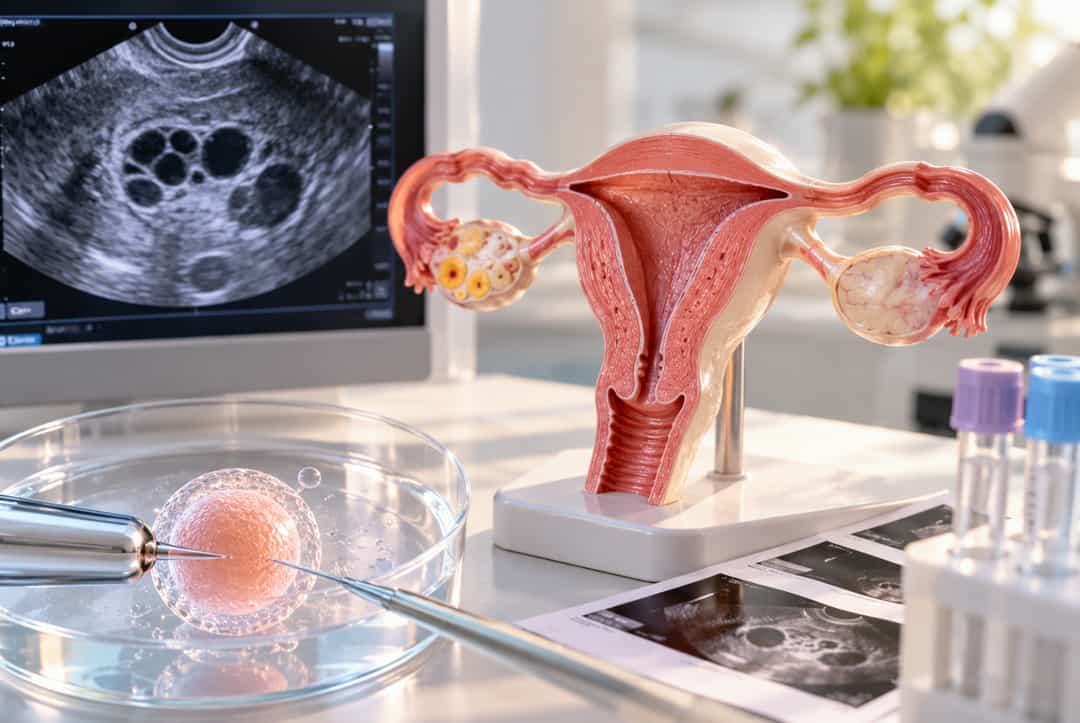
Another important examination is transvaginal ultrasound. Usually performed early in the menstrual cycle to observe the number of antral follicles in both ovaries; combined with information such as ovarian morphology and basal hormones, it can give doctors a more complete picture of ovarian reserve. For women preparing for IVF or third-generation IVF in Thailand, these results are also an important reference for doctors when assessing ovarian stimulation protocols and expected ovarian response. Older-age egg care can be grounded in evidence! Take 7 steps to understand your eggs’ “baseline” and take back control of your fertility!
Step 2: Don’t Just Know That You “Have a Period”—Also Find Out Whether You Are Ovulating Normally
Having regular periods does not mean that follicle development is exactly the same in every cycle.
If you have been trying to conceive for some time without success, your doctor may use serial ultrasound monitoring to observe the appearance, growth, and ovulation of the dominant follicle, and combine this with hormone markers such as LH, E2, and progesterone to assess the entire cycle.
Especially for older women, dynamic observation is often more meaningful than a single test on one day. What doctors really want to know is whether, over a complete cycle, follicles can be recruited, develop, mature, and eventually be released normally, and whether luteal function after ovulation is appropriate. Older-age egg care can be grounded in evidence! Take 7 steps to understand your eggs’ “baseline” and take back control of your fertility!
If you are preparing to enter an IVF cycle, this same approach is important. However, once the ovarian stimulation stage begins, doctors will continuously adjust medication based on the sizes of different follicles under ultrasound and hormone changes, rather than treating according to a fixed template.
Step 3: At-Home Monitoring Can Be Done, but It Should Not Replace Medical Examinations
Basal body temperature, ovulation test strips, and changes in cervical mucus can all be used as auxiliary methods to understand the ovulation window.
For example, ovulation test strips mainly detect changes in LH; when LH rises significantly, it suggests that ovulation may be approaching. Basal body temperature can provide some reference for determining whether ovulation has occurred through temperature changes before and after ovulation.
However, these methods are better suited for auxiliary observation, not as diagnostic tools. Especially for women with irregular menstrual cycles, polycystic ovary syndrome, or those already undergoing assisted reproductive treatment, relying solely on ovulation test strips to judge follicle maturity is not reliable.
When accurate judgment is truly needed, it should still be based on ultrasound and necessary hormone tests. Older-age egg care can be grounded in evidence! Take 7 steps to understand your eggs’ “baseline” and take back control of your fertility!
Step 4: When Preparing for Pregnancy at an Older Age, Don’t Ignore Your Body’s “Internal Environment”
Egg growth is not an isolated process.
From a follicle being recruited to the dominant follicle gradually maturing and finally ovulating, a series of complex endocrine regulations are involved. Therefore, thyroid function, glucose metabolism, insulin sensitivity, body weight, and overall nutritional status may all be part of a preconception assessment.
If there is significant obesity, menstrual irregularity, polycystic ovary syndrome, insulin resistance, or thyroid disease, targeted examination and management should be prioritized rather than relying solely on a particular “egg-nourishing supplement.”
For families preparing for overseas fertility treatment or cross-border childbirth or traveling to Thailand for third-generation IVF in Thailand, Huanqiu Xinsheng generally also recommends organizing previous examination records as completely as possible before departure. This allows doctors during consultation to understand ovarian reserve, menstrual cycles, and baseline physical condition more quickly, reducing duplicate tests and missing information.
Step 5: The Point of Nutrition Is Not “The More Supplements, the Better”
Many women begin buying CoQ10, folic acid, vitamin D, and various multinutrient supplements as soon as they start preparing for pregnancy.
But what really matters in nutrition management is “supplementing what you lack”, not supplementing as much as possible.
Protein, vegetables, fruits, whole grains, and healthy fats should form the foundation of your daily diet, while also paying attention to weight, blood sugar, and overall energy intake. If you have significant gastrointestinal disease, long-term diarrhea, constipation, or nutrient absorption problems, further evaluation can be done under a doctor’s guidance; there is no need to blindly undergo a large number of unconventional tests for the sake of “nourishing eggs.” Older-age egg care can be grounded in evidence! Take 7 steps to understand your eggs’ “baseline” and take back control of your fertility!
Nutrients such as CoQ10 can be discussed for use according to individual circumstances, but they cannot reverse the age-related decline in egg number, nor can they replace a proper fertility assessment.
Step 6: The Core Variable Truly Affecting Egg Quality—Age—Cannot Be Avoided
Eggs require a large amount of energy to complete maturation, fertilization, and early embryonic development, and mitochondria play an important role in energy supply. As women age, mitochondrial function in oocytes and chromosomal stability may also change.
This is also why, even if older women still have follicles, it cannot be simply understood as “if there are follicles, there must be high-quality eggs.”
For women over 35, especially around age 40, with declining ovarian reserve or who have already been trying to conceive for a long time, time itself is a fertility factor that needs to be considered. Rather than spending six months or even a year repeatedly trying various so-called “egg-nourishing plans,” it is more important to first complete a proper fertility assessment and then decide whether to continue trying naturally or consider IVF sooner.
Step 7: The Purpose of Testing Is to Decide What to Do Next
Doing all these assessments is ultimately not about getting a stack of test reports, but about answering one question: What should be done next?
If ovarian reserve, ovulation, and the basic conditions of both partners are good, you can continue trying to conceive naturally under a doctor’s advice. If you are older, have significantly reduced ovarian reserve, fallopian tube problems, abnormal semen parameters in the male partner, or have experienced infertility for a long time, it is important to go to a proper reproductive center as soon as possible to further evaluate assisted reproductive options. Older-age egg care can be grounded in evidence! Take 7 steps to understand your eggs’ “baseline” and take back control of your fertility!
For families planning third-generation IVF in Thailand, overseas fertility treatment, or cross-border childbirth, the same logic should apply: assess first, then formulate a plan—rather than deciding first that “IVF must be done” and then looking for test results that fit that decision.
In its overseas medical accompaniment services, Huanqiu Xinsheng also helps families organize previous examination records in advance, make hospital and doctor appointments, communicate consultation needs, and provides interpretation accompaniment after arrival in Thailand, itinerary coordination, and connection with medical processes, so that domestic examinations and overseas consultations form as continuous an information chain as possible.
Final Thoughts: When Preparing for Pregnancy at an Older Age, the Biggest Fear Is Not Age, but Spending Time in the Wrong Place
Preparing for pregnancy at an older age does not mean there is no chance, but the objective impact of age on ovarian reserve and egg quality also cannot be ignored.
Truly scientific “egg nourishment” is not about finding a miracle supplement. It is about first understanding your ovarian reserve, ovulation status, hormones, and metabolic state, and then deciding—based on age and both partners’ fertility conditions—whether to try naturally or proceed to IVF treatment.
Especially for families considering third-generation IVF in Thailand, overseas fertility treatment, or cross-border childbirth, the earlier a systematic assessment is completed, the easier it is to know where your time should be spent.
Taking back control of your fertility does not mean guaranteeing that every outcome will go as hoped. It means obtaining information as early as possible while choices still exist and making decisions that are more suitable for you.
— Huanqiu Xinsheng | Full-Cycle Fertility Management

- Previous
- Next