
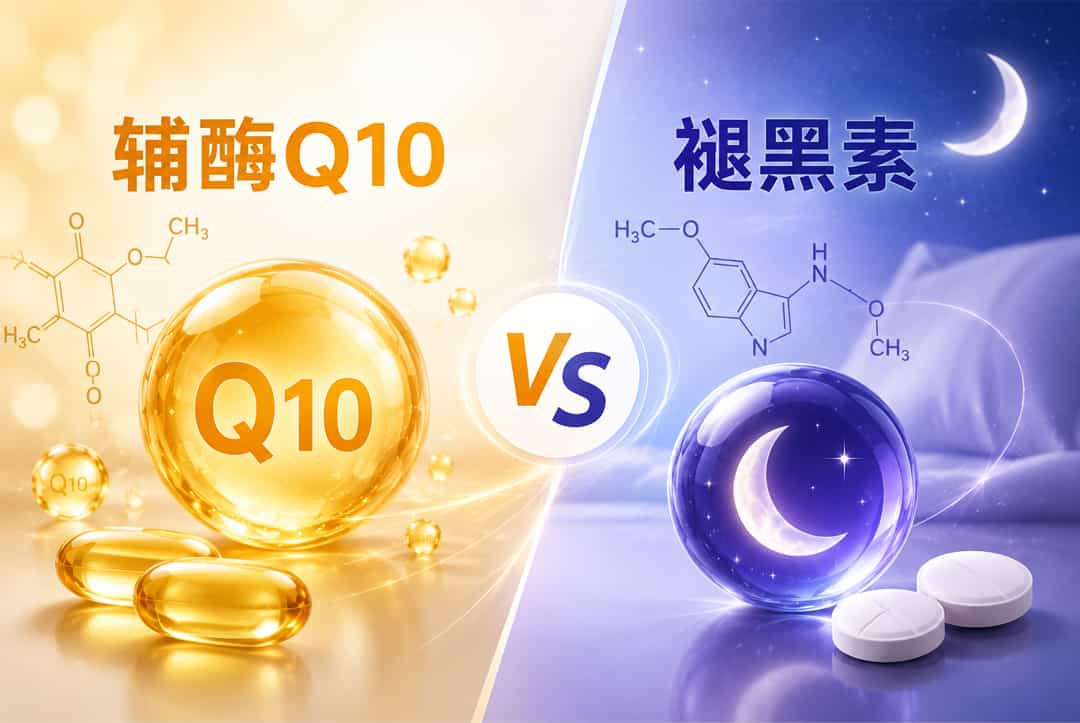
Coenzyme Q10 Meets a “New Rival”? Melatonin and Egg Quality, Explained Once and for All
When it comes to improving egg quality and preparing for IVF, many women may first think of Coenzyme Q10. However, as reproductive medicine research continues to advance, a growing number of studies are turning attention to another factor that has often been overlooked in the past—Melatonin.
Most people know melatonin because of "sleep." But its role in the human body goes far beyond helping regulate sleep rhythms. In the female reproductive system especially, melatonin can be found participating throughout the process—from follicle growth and oocyte maturation to ovulation and oxidative stress regulation.
For families preparing for pregnancy, getting ready for IVF, and especially those planning to travel to Thailand for third-generation IVF, understanding the factors that affect egg quality can also help build a more science-based understanding of the entire conception preparation process.
So here's the question: Why has melatonin been linked to egg quality? Can it actually replace Coenzyme Q10?
Today, Global New Life will start from the follicular microenvironment to explain this in detail.
01|Melatonin Is More Than Just a "Sleep Aid"—It Also Exists in the Follicular Microenvironment
Whether an egg ultimately matures successfully is not determined solely by age.
During follicle development, the oocyte is always situated within a complex microenvironment, and follicular fluid is a key component of this environment. It contains hormones, growth factors, metabolites, and a variety of substances with antioxidant properties—and melatonin is one worth paying attention to.
Research has found that as follicles continuously grow and mature, melatonin levels in the follicular fluid undergo dynamic changes, and concentrations before ovulation may even be notably higher than those in the blood.
Why does the follicle need such an environment? One important reason is to counteract oxidative stress.
02|Why Does Oxidative Stress Affect Egg Quality?
We can think of the oocyte as a cell that requires substantial energy to complete maturation, division, and subsequent development. In this process, mitochondria take on the crucial task of energy supply. However, as cells carry out energy metabolism, they also produce a certain amount of reactive oxygen species—what we often hear referred to as ROS.
Under normal conditions, the body's own antioxidant system can maintain balance. But when free radicals are produced in excess, or when antioxidant capacity is insufficient, this balance is disrupted and oxidative stress can develop. Aging, chronic sleep deprivation, mental stress, irregular routines, and certain physical conditions may all be related to changes in oxidative stress levels.
The oocyte is particularly sensitive to these changes. This is why, in the field of reproductive health, "antioxidation" has long been one of the key directions in conception preparation and assisted reproduction research.
03|How Exactly Does Melatonin Participate in Follicle Development?
What makes melatonin noteworthy is that it is not merely a "sleep-promoting ingredient" in the traditional sense. Studies have shown that it possesses considerable antioxidant capacity on its own, and it may also participate in regulating the body's own antioxidant defense system. For example, some studies have observed associations between melatonin and total antioxidant capacity (TAC), superoxide dismutase (SOD), and reactive oxygen species (ROS).
Furthermore, melatonin may also be involved in regulating mitochondrial function and cellular homeostasis through signaling pathways such as MT1/AMPK. In other words, its value is not simply about "helping people sleep better"—it may participate in oocyte growth and maturation at multiple levels, including the follicular microenvironment, mitochondrial function, and oxidative stress.
Some studies have also found a negative correlation between the DNA oxidative damage marker 8-OHdG and melatonin levels in follicular fluid. This provides researchers with a new direction for understanding the relationship between "melatonin—oxidative stress—oocyte quality."
04|How Far Has Melatonin Research Progressed in the Field of IVF?
This is also the question that concerns many families preparing for IVF the most. Currently, research on melatonin in assisted reproduction mainly focuses on two directions.
Category One: Laboratory Culture Environment
Some studies have attempted to add melatonin to in vitro culture systems to observe its effects on the maturation of immature oocytes and subsequent embryo development.
A related study published in the Journal of Pineal Research in 2020 showed that adding melatonin under specific in vitro maturation culture conditions was associated with improved maturation of immature oocytes and subsequent developmental potential. The researchers suggested that one possible mechanism is melatonin's regulation of mitochondrial function and the oxidative stress environment.
But a key point needs to be emphasized here: adding melatonin to laboratory culture media is a completely different concept from an individual taking melatonin on their own. Laboratory research findings cannot simply be interpreted as "taking melatonin will definitely improve egg quality."
Category Two: Exogenous Supplementation Studies
Beyond laboratory culture environments, some studies have also examined whether oral melatonin supplementation affects assisted reproduction outcomes. Earlier clinical observations conducted controlled studies on women who had unsatisfactory fertilization in a previous cycle, with one group receiving a certain dose of melatonin supplementation.
The results showed that some women in the supplementation group experienced improved fertilization in subsequent IVF cycles. This provides a certain basis of evidence for the use of melatonin in assisted reproduction, but at this stage, conclusions still need to be drawn in the context of sample size, study design, population differences, and specific treatment protocols.
Therefore, melatonin is better understood as an adjunctive avenue worthy of continued research, rather than a "miracle cure for egg quality."
05|Why Do Women with PCOS Also Frequently Appear in Melatonin Research?
Polycystic ovary syndrome, or PCOS, is a very common condition in reproductive medicine. Some women with PCOS may also experience ovulation abnormalities, metabolic issues, insulin resistance, or hyperandrogenism.
At the same time, some studies have found that, compared with certain normal control populations, melatonin levels in the follicular fluid of women with PCOS may differ, accompanied by changes in indicators such as lipid peroxidation, protein oxidation, and DNA oxidative damage.
As a result, researchers have begun to ask: If the oxidative stress environment inside the follicle can be improved, could the microenvironment surrounding the oocyte be further enhanced?
A considerable amount of research has already been conducted around melatonin, inositol, and other nutritional interventions. However, PCOS itself is highly heterogeneous—different women may have entirely different hormone levels, body weights, degrees of insulin resistance, and ovarian responses. Therefore, just because someone else found a particular supplement effective does not mean you should directly copy their protocol.
06|Can Melatonin "Replace" Coenzyme Q10?
At this point, many people may ask: Since melatonin is so important, does that mean Coenzyme Q10 is no longer important? The answer is not simply "one replaces the other."
Coenzyme Q10 and melatonin do overlap in some of the physiological mechanisms they target—for example, both are involved in mitochondrial function and oxidative stress—but they are not identical substances, nor can they be simplistically ranked against each other.
A more accurate understanding is this: Modern reproductive medicine increasingly recognizes that egg quality is influenced by multiple factors working together—age, genetic background, ovarian reserve, hormone levels, metabolic status, mitochondrial function, oxidative stress, and lifestyle. No single supplement can solve all problems. Especially for women preparing for third-generation IVF in Thailand, rather than endlessly searching for the so-called "miracle supplement," the more important step is to first complete relevant assessments such as AMH, antral follicle count, and sex hormone testing, and then discuss your individual situation with your doctor.
07|What's Truly Easy to Overlook Is Your Circadian Rhythm
This may be the most important point in the entire discussion. The human body produces melatonin on its own. Its secretion is closely tied to circadian rhythm, light exposure, and sleep habits. When you receive natural light during the day and the environment gradually darkens at night, the brain adjusts the body's biological clock based on these changes in light and darkness. But modern lifestyles tend to disrupt this mechanism.
Going to bed in the early hours, scrolling on your phone for long periods before sleep, staying exposed to bright light late into the evening, spending all day indoors... Even if you "get 8 hours of sleep" every day, if your sleep-wake cycle is chronically reversed, it does not mean your biological rhythms are in an ideal state.
For women preparing for IVF, currently managing ovarian function, or planning overseas fertility treatment, maintaining a regular routine is not merely an empty "wellness slogan." From a physiological perspective, it is closely connected to endocrine function, metabolism, and the normal secretion of melatonin.
08|Before Starting IVF, 4 Things More Important Than "What Supplement to Buy"
If you are currently preparing for pregnancy or getting ready to enter an IVF cycle, you may want to bring your focus back to your body itself.
First, try to establish a stable sleep routine.
Not just going to bed early one night, but gradually forming relatively consistent times for going to sleep and waking up.
Second, get appropriate natural light exposure during the day.
Light is one of the important signals the body uses to calibrate its circadian rhythm.
Third, maintain a balanced diet and moderate exercise.
Factors such as body weight, metabolic status, and insulin sensitivity may also affect women's reproductive health.
Fourth, do not stack large amounts of supplements on your own.
Coenzyme Q10, melatonin, inositol, vitamin D, and other nutritional supplements each have their own appropriate scenarios.
"It worked for someone else" does not mean it is right for you. Especially for those who have already entered the ovarian stimulation, egg retrieval, or embryo transfer phase, before adding any medication or supplement, it is recommended to confirm with your own doctor first.
09|Preparing for Overseas Fertility Treatment Requires Both Physical Preparation and Trip Planning
For families planning overseas fertility treatment and cross-border childbirth, preparation is not as simple as booking flights and choosing a hospital. Especially when choosing third-generation IVF in Thailand, every stage has its own timeline—from preliminary examinations in your home country, to in-person consultations in Thailand, ovarian stimulation, follicle monitoring, egg retrieval, embryo culture, PGT screening, and subsequent transfer.
If the preliminary health assessment and travel timing to Thailand are not properly coordinated, schedules can easily require repeated adjustments. This is why Global New Life places strong emphasis on early-stage information organization and timeline planning when providing overseas medical accompaniment and Thailand travel process services.
We hope to help every family understand in advance: What is your current physical condition? What examinations need to be prepared? When is the right time to travel to Thailand? How is the overall IVF cycle likely to be arranged? What matters should be confirmed with your doctor in advance? When these questions are clarified ahead of time, many things will naturally feel much more manageable once you actually enter the cycle.
Final Thoughts
From Coenzyme Q10 to melatonin, people have been searching for ways to improve egg quality. But as research becomes more and more in-depth, one thing becomes increasingly clear: What truly affects reproductive health is never a single so-called "miracle ingredient," but rather the combined result of age, ovarian reserve, hormones, metabolism, lifestyle, and medical protocols.
Melatonin research has allowed us to re-examine the possible connections between sleep, circadian rhythms, oxidative stress, and the follicular microenvironment, and it has opened new directions for assisted reproduction research. But the core of science-based conception preparation has never been blindly searching for a "magic pill."
Regular sleep, a balanced diet, moderate exercise, and proper medical testing—then developing a plan suited to your individual circumstances—are the more reliable ways to prepare.
For families planning IVF, third-generation IVF in Thailand, overseas fertility treatment, or cross-border childbirth, Global New Life also hopes that through professional preliminary consultation, travel planning, hospital appointments, translation support, and overseas medical accompaniment services, we can make the complex cross-border process clearer and more manageable.
There is no one-size-fits-all answer when it comes to conception, but every careful preparation you make helps the next step feel more confident.
Global New Life — Walking with you, step by step, through the complex journey of overseas fertility treatment.
This article is educational content on reproductive health, provided solely for health knowledge exchange. Whether melatonin or other medications and nutritional supplements are suitable for individual use should be determined based on your own circumstances and in consultation with a qualified physician. Self-adjustment of dosages or substitution of existing treatment protocols is not recommended.

- Previous
- Next